
POUSTEVNÍK – láska
Primární význam
Obrácený význam
Popis
In love, THE HERMIT is one of the most challenging cards, because it asks for silence where we fear silence the most.
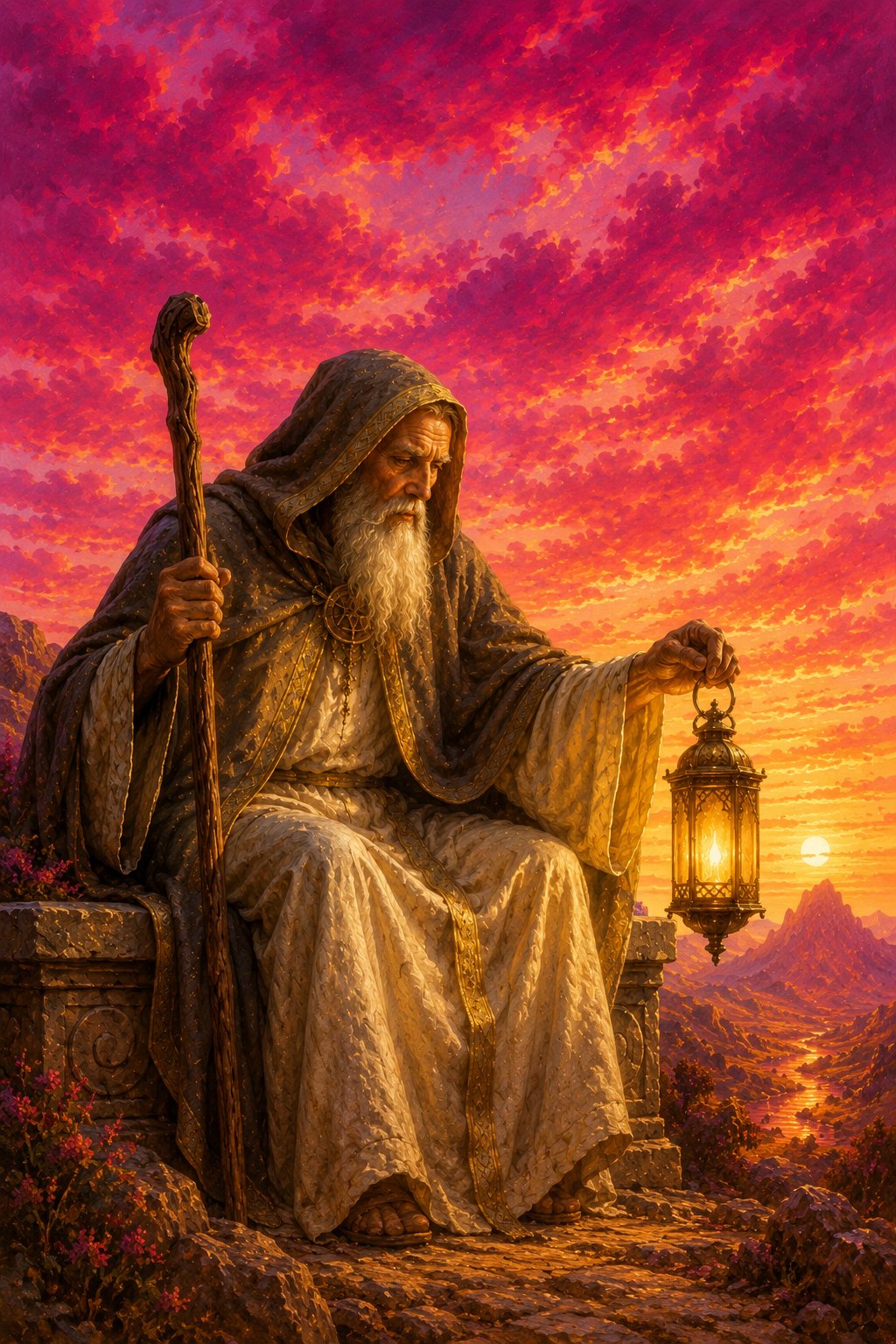
Look closely at the card, where an old man in a grey cowl stands on a snowy mountain peak, a lantern in his hand, surrounded by snow, silence, and a dark blue sky — nothing else, no house, no road, no other person.
And notice that he is looking down: he has reached the summit, and he is not looking at the sky, but at the path he came from.
There is a difference here that is worth knowing precisely: one chooses solitude, while loneliness happens to them. This old man chose it — and this card now asks you which one you are living in.
If you are in a relationship, this card does not signify a breakup, but rather distance: that not every minute can be spent together. For someone who is never alone has nothing to bring home to the other — two empty people cannot fill each other.
So, ask for an evening for yourself, and don't over-explain it. You are not withdrawing from them, but to yourself.
If you are alone, then look at the lantern: it does not hold a flame, but a six-pointed star, and how small that light is — one can only see two steps ahead from it. You won't get a map of when and who is coming, you only get enough light for the next step.
And now the most important thing: he does not pull the lantern towards himself, but holds it out into the darkness. He is not lighting it for himself — someone else is coming from below. If you are alone now, your life is not empty, but you are lighting the way for someone who is still on their way to you.
In a reversed position, however, seclusion is at work: you are no longer alone to listen, but because you have grown accustomed to it, and slowly you perceive every approach as a burden. For those who stay up too long, silence will not be a sanctuary, but a habit.
The snow, however, is the price of the card: the air is clear up there, but it is cold, and there is no one to share the view with. Do not stay up there forever.
Zpráva
He who is never alone has nothing to bring home to the other.
Look closely at the card, where an old man with a white beard and a gray robe stands on a snowy mountain peak, holding a lantern in front of him, surrounded by snow, silence, and a dark blue sky — nothing else, no house, no road, no other person.
And notice the most important thing: he is looking down. He has reached the summit, and he is not looking at the sky, but at the path he came from.
This is your message tonight, because there is a difference here that you need to know precisely: one chooses solitude, while loneliness happens to them. This old man chose it — and this card now asks you which one you are living in.
If you are in a relationship, this card does not signify a breakup, but distance: that not every minute can be spent together, because two empty people cannot fill each other. Ask for an evening for yourself, and don't over-explain it — you are not withdrawing from him, but to yourself.
If you are alone, then look at the lantern, because it does not hold a flame, but a six-pointed star. And notice how small that light is: it does not illuminate the mountain, one can only see two steps ahead from it.
So you won't get a map of when someone is coming and who it will be — you only get enough light for the next step. And he who does not start until he sees the end, will never start.
And now the most important thing: he does not pull the lantern towards himself to see better, but holds it forward, outward, into the darkness. He is not lighting it for himself — someone else is coming from below, and he knows they are coming, because he also came once.
If you are alone tonight, hear this: your life is not empty. You are lighting the way for someone who is still on their way to you.
But the snow is also the price of the card: the air is clean up there, only cold, and there is no one to share the view with. Don't stay up forever: the hermit did not go up there to die, but to have something to bring down.
In a reversed position, withdrawal becomes isolation: you are no longer alone to hear, but because you have gotten used to it — and slowly you experience every approach as a burden.