Apskatiet pa dzīves jomām
The Seven of Swords is a card of strategy and caution: sometimes it is worthwhile to proceed with cleverness and skillful planning. But pay attention to stay honest with your own integrity and with others too.
Honesty is returning, and the straightforward path pays off. The card's request: choose the clear, honest way.
Correspondences — Element: Air · Color: Swords · Rank: Seven · Yes–No: No – not like this
The Card's Image and Symbolism
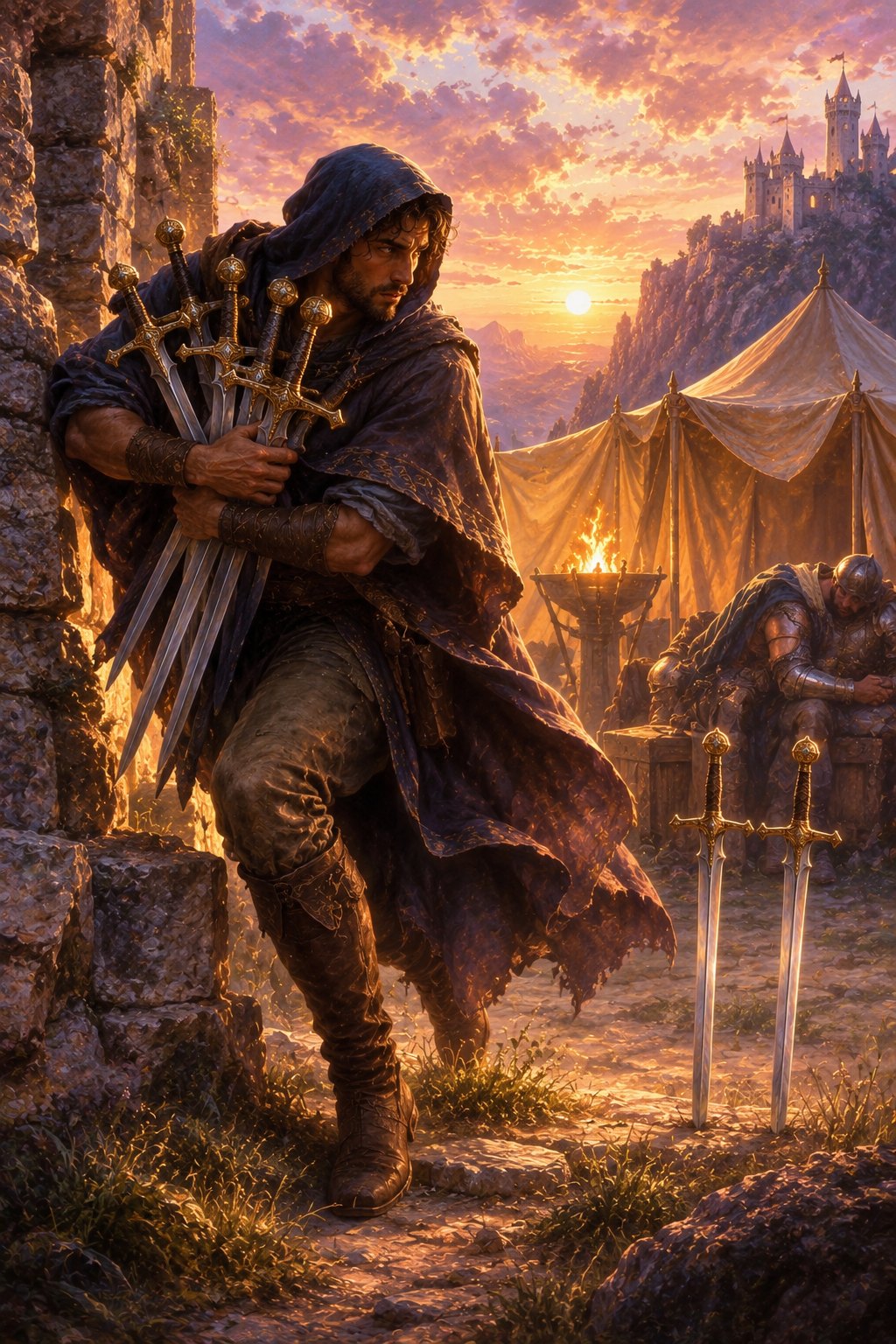
A man sneaks out of a camp, clutching five swords, tiptoeing. He turns back and smiles. Behind him are tents, soldiers, a campfire – they don't even notice him. Two swords remain in the ground, where he came from.
Everyone remembers the smile. Yet, the true secret of the card is not that he is stealing. But his posture: he moves forward, but looks back. He doesn't even see where he is stepping.
This is the Seven of Swords. He who proceeds in this manner will sooner or later fall – not because he gets caught, but because he doesn't watch his path.
The five swords he carries
The five swords are in his grasp, clenched, uncomfortably. This is not how one should carry a sword. It's heavy, slippery, both hands are occupied.
This is the price of the card. He who lives with half-truths must constantly hold onto something. He must remember what he said to whom. He must be vigilant. And this is exhausting – much more exhausting than telling the truth directly.
Deception is not difficult because it is immoral. It is difficult because you have to constantly work on it.
The two swords that remain
He couldn't take two. They stand in the ground, in the middle of the camp.
This is the most subtle detail of the card. He who acquires something in this way never takes the whole thing home. Something always remains on the shore – and that something is usually the most important thing: the peace of not having to explain yourself.
Cunning or self-deception?
This card is not always about others. Very often, you are both the camp and the thief.
Most often, we tell ourselves half-truths. That it's just this once. That starting next week. That you didn't even want it that much. That it doesn't even hurt.
The Seven of Swords then asks a cruelly simple question: what do you know about yourself that you don't say out loud?
Acting alone
This card also belongs to the solitary strategist. One who doesn't ask for help. One who would rather do it alone than share. One who is secretive not because of malicious intent – but because they don't trust.
And sometimes there's a good reason for this. Sometimes it's truly not wise to tell everything. The card doesn't forbid strategy: it warns that strategy and escape look the same from the outside.
The camp that doesn't notice
No one is looking. The soldiers sit by the fire, the tents are quiet. And he simply walks out.
This detail also conveys two messages. One: often something goes wrong not because someone is evil. But because no one is paying attention. If someone is taking something from you now – time, credit, money, energy – it might not even be particularly hidden. You just aren't looking.
And the other is this: sometimes you are the camp. And you don't notice what you are taking from yourself.
The smile
The smile on his face is the most honest thing on the card. He enjoys it. There's something intoxicating about cunning: that you know, and they don't.
This is precisely the trap. It's not guilt that stops a person, but exhaustion – just much later.
If this card has come to you now, the question is not whether you will get away with it. You probably will. The question is whether it's worth living this way.